REaCH: taking a first-responder IoT product from ambiguity to field validation
Led an 11-person team building a real-time health and incident dashboard, secured funding, and tested the product with frontline users.
- My role
- Founding product manager across discovery, roadmap, design, delivery, and field learning
- Timeframe
- Zero-to-one MVP
- Evidence boundary
- $1.5M funding and 22-station testing are realized. The product was a field-tested MVP, not a scaled production platform.
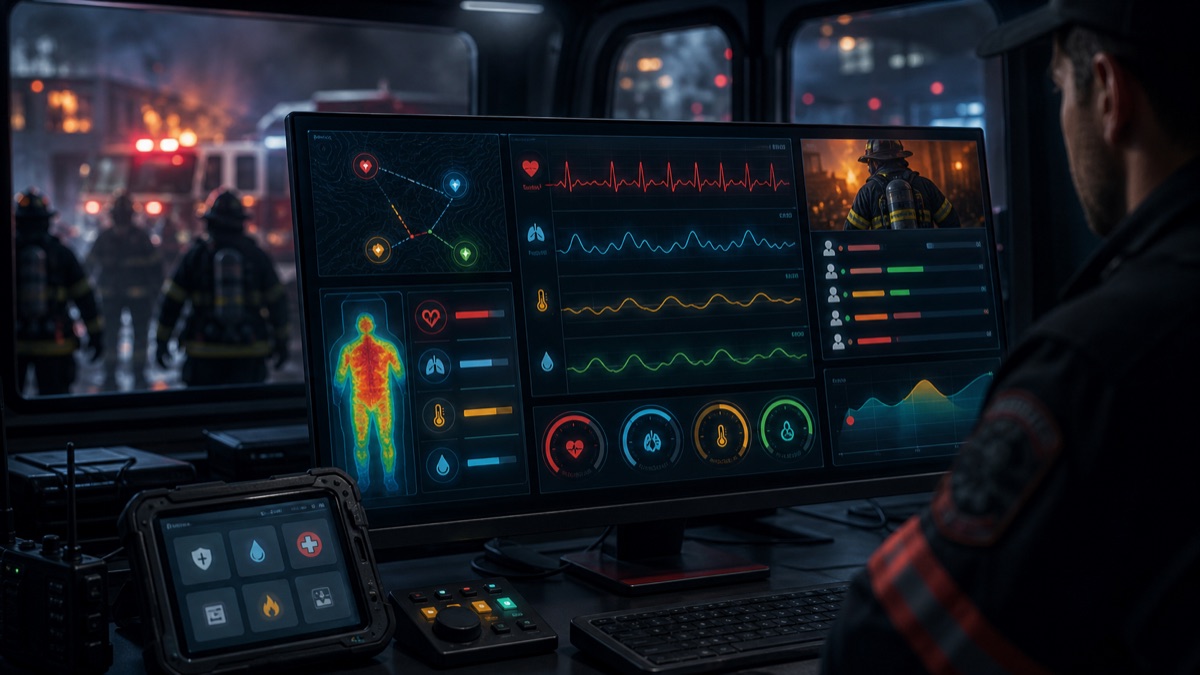
The problem
Firefighters operate in environments where heat, exertion, oxygen, location, and crew status can change quickly. The opportunity was broad, safety-critical, and technically uncertain: turn wearable and incident signals into information that commanders could use without overwhelming them.
Product discovery
I translated an ambiguous mission into testable user needs through interviews, field observation, workflow mapping, and prototype feedback. I led an 11-person cross-functional team and balanced the need to learn quickly with reusable front-end and data patterns.
Leadership under pressure
During an important demonstration, I had not tested the devices early enough in the customer’s actual network environment. I disclosed the failure, recovered the session, preserved the feedback opportunity, and created a permanent readiness mechanism that included environment validation rather than assuming lab behavior would transfer.
I also resolved a front-end architecture disagreement by first understanding the technical lead’s concern, then bounding the MVP while retaining reusable patterns where repeated rework would be costly.
Outcome
The team secured $1.5M in funding and advanced the product to testing across 22 fire stations. The evidence demonstrates funded, field-validated product leadership; it does not claim broad production adoption.
What I learned
In zero-to-one work, trust grows when a leader makes uncertainty visible, tests in the real operating environment, and responds to failure without hiding it.